Difference Between B.Sc Agriculture vs B.Tech Agriculture Engineering: Eligibility, Scope, Salary & Career Guide (2026)
Choosing the right agriculture course after Class 12 is an important decision that can shape your future career. Among the most popular undergraduate courses in the agriculture field are B.Sc Agriculture vs B.Tech Agriculture Engineering. Although both courses belong to the agriculture sector, they are quite different in terms of curriculum, career opportunities, skills required, and job profiles.
Many students become confused while selecting between these two courses because both offer excellent career opportunities in agriculture. However, the right choice depends on your interests, academic background, and long-term career goals. If you are interested in crop production, plant science, soil management, and agricultural research, B.Sc Agriculture may be the ideal option. On the other hand, if you enjoy engineering, machinery, irrigation systems, technology, and automation, B.Tech Agriculture Engineering could be a better fit.
In this detailed guide, we will compare both courses based on eligibility, admission process, subjects, career scope, salary, government jobs, higher education opportunities, and future prospects to help you make an informed decision.
What is B.Sc Agriculture?
B.Sc Agriculture, or Bachelor of Science in Agriculture, is a four-year undergraduate degree focused on agricultural science and modern farming practices. The course is designed to provide students with scientific knowledge about crop production, soil fertility, horticulture, genetics, plant breeding, pest management, agricultural economics, and sustainable farming.
Students gain both theoretical knowledge and practical experience through laboratory work, field visits, and rural agricultural training. The programme prepares graduates to solve real-world agricultural challenges and contribute to increasing food production using scientific methods.
A B.Sc Agriculture graduate can work in government departments, seed companies, fertilizer industries, research institutions, banks, agribusiness firms, and agricultural startups. The course also provides a strong foundation for higher education such as M.Sc Agriculture, MBA in Agribusiness, and Ph.D. programmes.
Read this article for better Clarity on B.Sc Agriculture
What is B.Tech Agriculture Engineering?
B.Tech Agriculture Engineering is a four-year engineering programme that combines engineering principles with agricultural science. The main objective of this course is to develop technologies, machinery, irrigation systems, and engineering solutions that improve agricultural productivity and efficiency.
Students study engineering mathematics, engineering mechanics, soil and water engineering, farm machinery, irrigation engineering, renewable energy, food processing, agricultural automation, robotics, and precision farming technologies. Practical training includes workshop sessions, industrial internships, CAD design, and project work.
With the growing adoption of smart farming, drones, IoT, and AI in agriculture, Agriculture Engineering has become one of the fastest-growing branches of engineering in India.
Key Differences Between B.Sc Agriculture vs B.Tech Agriculture Engineering
Although both courses are related to agriculture, their approach is entirely different.
B.Sc Agriculture focuses on improving crop production, plant health, soil management, and agricultural research. Students learn scientific methods to increase agricultural productivity and support farmers through better farming practices.
B.Tech Agriculture Engineering focuses on designing agricultural machinery, irrigation systems, food processing equipment, renewable energy solutions, and modern farming technologies. Engineering principles are applied to solve agricultural problems using innovation and technology.
In simple words, B.Sc Agriculture teaches how to grow better crops, while B.Tech Agriculture Engineering teaches how to build better tools and technologies for farming.
Subscribe
Eligibility Criteria for B.Sc Agriculture vs B.Tech Agriculture
The eligibility requirements for these two courses are different.
For B.Sc Agriculture, students who have completed Class 12 with Physics, Chemistry, and Biology (PCB), Physics, Chemistry, and Mathematics (PCM), or PCMB are eligible in many universities. The minimum marks required generally range from 50% to 60%, depending on the institution.
For B.Tech Agriculture Engineering, candidates must have studied Physics, Chemistry, and Mathematics (PCM) in Class 12. Mathematics is compulsory because the curriculum includes engineering mathematics, mechanics, hydraulics, and design-related subjects.
Students should always check the eligibility criteria of the university before applying.
Admission Process
Admission to B.Sc Agriculture is generally offered through entrance examinations such as ICAR UG, CUET UG, BCECE, state-level agriculture entrance exams, or university-specific entrance tests. Some private universities also offer admission based on merit.
Admission to B.Tech Agriculture Engineering is usually based on engineering entrance examinations such as JEE Main, BCECE, state engineering entrance exams, CUET, or university-level engineering entrance tests.
After qualifying for the entrance examination, candidates participate in counselling, where seats are allotted based on rank, reservation policy, and college preference.
Course Curriculum: B.Sc Agriculture vs B.Tech Agriculture
The curriculum of B.Sc Agriculture focuses on agricultural sciences, while B.Tech Agriculture Engineering focuses on engineering and technology.
Students pursuing B.Sc Agriculture study subjects like Agronomy, Soil Science, Horticulture, Genetics, Plant Breeding, Agricultural Economics, Plant Pathology, Entomology, Seed Technology, Agricultural Extension, and Organic Farming.
In contrast, Agriculture Engineering students study Engineering Mathematics, Engineering Mechanics, Soil and Water Engineering, Farm Machinery, Hydraulics, Irrigation Engineering, Renewable Energy, CAD, Food Process Engineering, and Precision Agriculture.
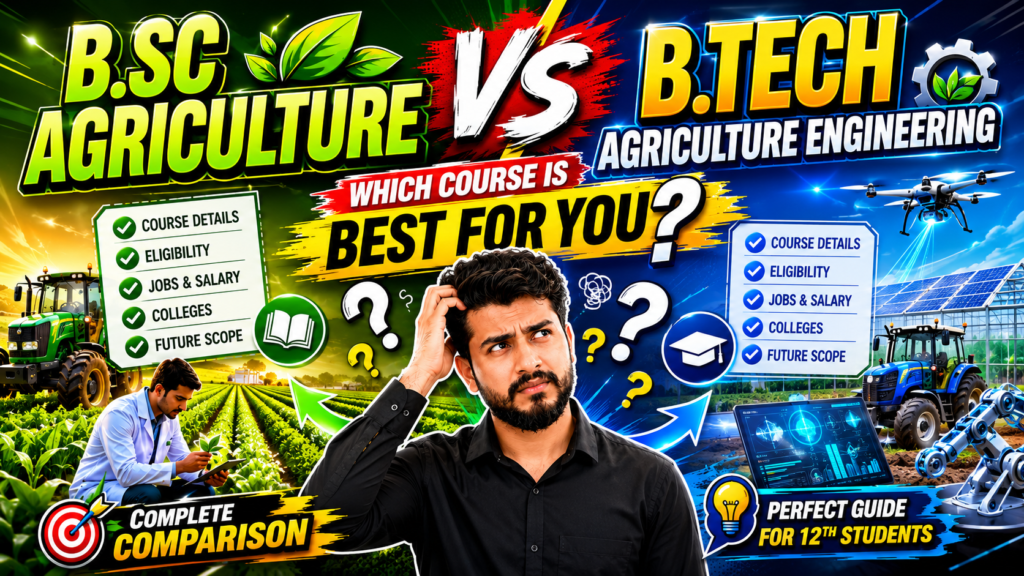
Which Course Should You Choose? B.Sc Agriculture vs B.Tech Agriculture
Choosing between these two courses depends entirely on your interests and career goals.
If you enjoy biology, plant sciences, farming, and agricultural research, B.Sc Agriculture is the better option. It opens doors to careers in government agriculture departments, research organizations, banks, agribusiness companies, and agricultural consultancy.
If you enjoy mathematics, physics, engineering, and modern technologies such as drones, automation, and smart farming, B.Tech Agriculture Engineering is an excellent choice. It offers opportunities in engineering companies, food processing industries, irrigation projects, renewable energy, and agricultural technology firms.
Both courses have excellent career prospects, and neither is superior to the other. The best course is the one that matches your strengths and interests.
Conclusion of B.Sc Agriculture vs B.Tech Agriculture
The agriculture sector is changing rapidly with the adoption of advanced technologies, climate-smart farming, and sustainable agricultural practices. Both B.Sc Agriculture and B.Tech Agriculture Engineering play a vital role in this transformation.
B.Sc Agriculture focuses on scientific farming, crop improvement, and agricultural research, while B.Tech Agriculture Engineering emphasizes engineering innovation and technological solutions for modern farming.
Students should evaluate their academic background, preferred subjects, and career aspirations before making a decision. Those interested in biological sciences and farming may find B.Sc Agriculture more suitable, whereas students passionate about engineering and technology should consider B.Tech Agriculture Engineering.
Both degrees offer rewarding careers, excellent government and private job opportunities, and strong potential for higher education and entrepreneurship.
Frequently Asked Questions (FAQs) B.Sc Agriculture vs B.Tech Agriculture
Q1. Which course is better, B.Sc Agriculture or B.Tech Agriculture Engineering?
The better course depends on your interests. B.Sc Agriculture is ideal for students interested in crop science and farming, while B.Tech Agriculture Engineering is better for those interested in engineering and agricultural technology.
Q2. Is Mathematics compulsory for B.Tech Agriculture Engineering?
Yes, Mathematics is a compulsory subject for admission to most B.Tech Agriculture Engineering programmes.
Q3. Can PCB students apply for B.Tech Agriculture Engineering?
Generally, no. Most universities require Physics, Chemistry, and Mathematics (PCM) for admission.
Q4. Which course offers better government job opportunities ?
Both courses provide government job opportunities. B.Sc Agriculture graduates are eligible for Agriculture Officer and related posts, while Agriculture Engineering graduates can apply for engineering and technical positions.
Q5. Which course has a higher salary?
B.Tech Agriculture Engineering graduates often receive slightly higher starting salaries in the private sector, while experienced professionals from both fields can earn competitive salaries depending on their skills and experience.
Q6. Can I pursue higher education after these courses?
Yes. B.Sc Agriculture graduates can pursue M.Sc Agriculture, MBA, or Ph.D., while B.Tech Agriculture Engineering graduates can pursue M.Tech, MBA, MS, or Ph.D.
Leave a Comment
Have questions about B.Sc Agriculture or B.Tech Agriculture Engineering? Share your doubts in the comments section below. The team at Agrifair.in is here to help you with agriculture courses, admissions, entrance exams, colleges, scholarships, and career guidance.
If you found this article helpful, share it with your friends and classmates who are planning a career in agriculture.